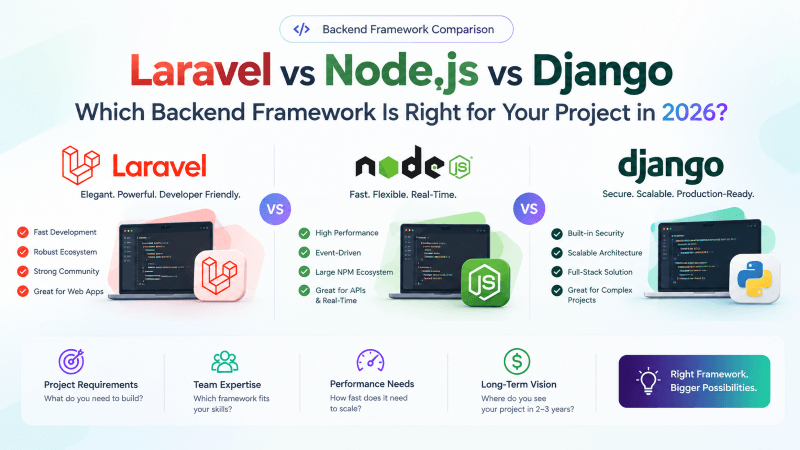
Choose Laravel if you need a fast, cost-effective build with a CMS-like admin panel — perfect for business websites, e-commerce, and SaaS MVPs. Choose Node.js if you're building real-time applications (chat, streaming, live data) or a JSON API-heavy microservices architecture. Choose Django if you're doing heavy data processing, AI/ML integration, or need a batteries-included framework with built-in security and admin.
Every founder and product manager faces this decision early. Pick wrong, and you'll either pay too much, launch too late, or hit a wall when you try to scale.
This guide gives you a practical, honest comparison — with real project examples from our 125+ builds — so you can make the right call for your specific situation.
What We're Actually Comparing
Before the data, let's set expectations. We're comparing three production-ready backend frameworks used by companies ranging from solo founders to Fortune 500s:
| Framework | Language | Maintained By | Used By | Best For |
|---|---|---|---|---|
| Laravel | PHP | Laravel LLC | Cash App, Pfizer, BBC, 9GAG | Business apps, CMS, e-commerce, MVPs |
| Node.js (Express / NestJS) | JavaScript / TypeScript | OpenJS Foundation | Netflix, Uber, PayPal, LinkedIn, Trello | Real-time apps, APIs, microservices |
| Django | Python | Django Software Foundation | Instagram, Spotify, Pinterest, YouTube | Data-heavy apps, AI/ML, content platforms |
All three are battle-tested. All three have strong ecosystems. The question isn't "which is best" — it's "which is best for YOUR project."
The Comparison: 8 Dimensions That Matter
1. Development Speed & Time to Market
| Feature | Laravel | Node.js | Django |
|---|---|---|---|
| Time to MVP | ⚡ Fastest (2–6 weeks) | ⚡ Fast (3–8 weeks) | ⚡ Fast (3–6 weeks) |
| Why? | Artisan CLI, Blade templating, pre-built Auth, Eloquent ORM, massive ecosystem of packages (Larastarters, Filament, etc.) | NPM ecosystem, mature tooling, but more decisions needed for structure | Batteries-included: admin panel, ORM, auth, migrations built in |
Winner: Laravel — Laravel's artisan commands, pre-built authentication, Blade templating, and packages like Filament Admin and Laravel Cashier make it remarkably fast to go from zero to a working product. For MVPs and business applications, nothing beats it for speed.
Django comes very close with its auto-generated admin panel and built-in ORM. Node.js (especially Express) is fast for APIs but requires more architectural decisions upfront.
2. Performance & Scalability
| Metric | Laravel | Node.js | Django |
|---|---|---|---|
| Request handling | ~2,000 req/s (with Octane) | ~15,000–30,000 req/s | ~3,000–5,000 req/s |
| Concurrency | Synchronous (async via Laravel Octane) | Event-driven, non-blocking, native async | Synchronous (async via Channels/ASGI) |
| Scaling strategy | Horizontal (more servers) + caching | Horizontal + vertical, efficient resource use | Horizontal + caching + worker processes |
| Best for scale | High-traffic content sites, SaaS | Real-time apps, streaming, high-I/O APIs | Data-heavy platforms, ML pipelines |
Winner: Node.js — Node's event-driven, non-blocking architecture handles thousands of concurrent connections with minimal resources. For I/O-heavy or real-time applications, Node is the clear leader.
Important caveat: Most projects never reach the scale where these differences matter. A well-optimized Laravel or Django app handles millions of requests per day. Don't choose based on theoretical peak performance if your current traffic is measured in thousands.
3. Development Cost
| Cost Factor | Laravel | Node.js | Django |
|---|---|---|---|
| Avg hourly rate (global) | $25–$60 | $30–$80 | $35–$75 |
| Developer availability | High (largest ecosystem in PHP) | Very high (JavaScript is everywhere) | Moderate (Python developers are costlier) |
| Typical MVP cost | $10K–$25K | $15K–$35K | $15K–$30K |
| Hosting cost (basic) | $10–$50/mo (shared/VPS) | $5–$40/mo (Node is lightweight) | $10–$60/mo |
Winner: Laravel — The combination of fast development speed and lower average developer rates makes Laravel the most cost-effective option for most business applications. You get more features built in less time for less money.
4. Learning Curve & Developer Availability
| Metric | Laravel | Node.js | Django |
|---|---|---|---|
| Difficulty for new devs | Low-to-medium | Medium | Medium |
| Global developer pool | Very large (PHP still powers 77% of the web) | Largest (JavaScript developers are everywhere) | Large (Python devs are growing fast) |
| Quality of documentation | Excellent (Laracasts, extensive docs) | Good (MDN, official docs, varies by framework) | Excellent (official docs, Django Girls, etc.) |
Winner: Tie (Laravel & Node.js) — Laravel has the gentlest learning curve with the best learning resources. Node.js has the largest developer pool globally. Django is well-documented but Python developers cost more.
5. Ecosystem & Packages
| Component | Laravel | Node.js | Django |
|---|---|---|---|
| Package manager | Composer | NPM (largest package registry) | pip |
| Notable packages | Spatie, Laravel Cashier, Horizon, Filament, Telescope, Socialite | Express, NestJS, Socket.io, Prisma, Next.js (full-stack) | Django REST Framework, Celery, Channels, Allauth |
| Admin panel | Built-in (Filament, Nova, Backpack) | Third-party (Strapi, AdminJS) | Built-in (Django Admin) |
| Auth system | Built-in (Breeze, Jetstream, Fortify) | Third-party (Passport.js, NextAuth) | Built-in (Django Auth) |
| ORM | Eloquent (beautiful, intuitive) | Prisma, TypeORM, Sequelize | Django ORM (powerful, mature) |
Winner: Laravel — The Laravel ecosystem is arguably the most cohesive in web development. First-party packages for auth, cashier (Stripe/Braintree), socialite (OAuth), scout (search), horizon (queues), telescope (debugging), and vapor (serverless) all work together seamlessly. Spatie's packages alone are worth the price of entry.
6. Security
| Feature | Laravel | Node.js | Django |
|---|---|---|---|
| XSS Protection | Built-in (Blade escaping) | Manual (varies by framework) | Built-in (template auto-escaping) |
| CSRF Protection | Built-in | Manual | Built-in |
| SQL Injection | Protected via Eloquent | Protected via ORMs | Protected via ORM |
| Auth best practices | Built-in (hashed passwords, remember tokens) | Manual implementation | Built-in |
| Security track record | Excellent (dedicated security team) | Good (ecosystem is large and uneven) | Excellent (used by Instagram, Pinterest) |
Winner: Tie (Laravel & Django) — Both frameworks take security seriously and protect against OWASP Top 10 by default. Django's permission system is slightly more mature for enterprise apps. Laravel's ecosystem makes it easy to implement 2FA, email verification, and role management.
7. Real-Time Capabilities
| Feature | Laravel | Node.js | Django |
|---|---|---|---|
| WebSockets | Laravel Echo + WebSockets / Pusher | Native via Socket.io or ws | Django Channels |
| Real-time dashboards | Possible (requires additional setup) | Excellent (native async I/O) | Possible (requires Channels + ASGI) |
| Live updates | Laravel Livewire + Reverb | Excellent via WebSockets | HTMX + Django + Channels |
| Best use case | Moderate real-time needs | Heavy real-time (chat, gaming, live data) | Moderate real-time needs |
Winner: Node.js — This is Node's superpower. If your app needs real-time collaboration (like Google Docs), live chat (like Slack), streaming data (like trading platforms), or WebSocket-heavy interactions — Node.js is the natural choice.
8. Data Science / AI / ML Integration
| Metric | Laravel | Node.js | Django |
|---|---|---|---|
| Python/ML libraries | PHP-Python bridge or microservice | Python microservice or child process | Native (same language as ML stack) |
| Integration difficulty | Moderate (cross-language) | Moderate (cross-language) | Trivial (Python ecosystem) |
| Best for | Integration with existing ML APIs | Light ML via TensorFlow.js | Full ML pipeline, data processing, NLP |
Winner: Django — If your product involves data processing, machine learning, natural language processing, or AI-powered features, Django is the natural fit. Most data science tools are Python-native (PyTorch, TensorFlow, scikit-learn, pandas, NumPy), and running them in the same stack eliminates cross-language communication overhead.
The Quick Decision Matrix
Here's a simple table to help you decide:
| Your Priority | Choose This |
|---|---|
| Fastest time to market | Laravel |
| Lowest development cost | Laravel |
| Real-time features (chat, live data, streaming) | Node.js |
| High-traffic API / microservices | Node.js |
| AI/ML integration | Django |
| Heavy data processing | Django |
| Enterprise admin panels & dashboards | Laravel (Filament) |
| Content-heavy platform / CMS | Laravel |
| Mobile app backend | Node.js (or Laravel with Sanctum) |
| Budget-friendly MVP | Laravel |
| Serverless architecture | Laravel (Laravel Vapor) or Node.js |
| Maximum developer availability | Node.js (or Laravel) |
When to Use a Hybrid Approach
Some of our best projects use a combination of frameworks:
- Example 1: SaaS with Real-Time Features
Backend: Laravel (business logic, user management, billing)
Real-time service: Node.js (WebSocket server for live updates)
Why: Laravel handles the complex business logic quickly; Node.js handles real-time communication efficiently. - Example 2: E-Commerce Platform with Recommendations
Backend: Laravel (catalog, cart, orders, admin)
ML service: Django + PyTorch (product recommendations, search ranking)
Why: Laravel builds the e-commerce features 2× faster; Django runs the ML models natively. - Example 3: Marketplace Platform
Backend: Laravel (listings, users, payments, messaging)
API Gateway: Node.js (rate limiting, caching, routing)
Why: Laravel for rapid feature development; Node.js for high-throughput API management.
A hybrid approach gives you the best of both worlds — but it adds complexity. Only go hybrid if one framework genuinely can't handle part of your requirements.
What We Actually Use at ProgigaTech
We believe in using the right tool for the job. Here's what we've found works best across our 125+ projects:
70% of projects → Laravel
Laravel is our go-to for most projects because:
- It's the fastest framework to build in (MVPs in 6–8 weeks)
- The ecosystem is unmatched (Filament, Spatie packages, Cashier, Horizon)
- PHP hosting is cheap and widely available
- It scales well with proper caching and database optimization
- The developer talent pool is large and rates are competitive
15% of projects → Django
Django wins when the project involves significant data processing, ML/AI features, or when the client's in-house team works in Python.
10% of projects → Node.js (NestJS)
Node.js is our choice for real-time applications, high-throughput APIs, and microservices architectures.
5% of projects → Hybrid
Combining Laravel + Node.js or Laravel + Django for specialized needs.
Real Project Examples
FitnessKriya (MVP → Full Platform)
Framework: Laravel + MySQL
Why Laravel: Needed rapid MVP development (8 weeks), complex business logic (scheduling, subscriptions, multi-currency), and a powerful admin panel.
Results: MVP in 8 weeks, full platform in 6 months, 3× YoY growth
Healifyy (Private Practice Website)
Framework: Laravel + Bootstrap
Why Laravel: Needed content management, client portal, appointment scheduling, and payment processing — all built in a 4-week timeline.
Results: Launched in 4 weeks, 5-star client rating
PdF Slider (Content Platform)
Framework: Laravel
Why Laravel: Content-heavy platform needing excellent caching, SEO, and search functionality.
Results: Handles thousands of daily visitors with sub-second load times
How to Make Your Decision
Still unsure? Here's a simple 3-step process:
Step 1: List your top 3 constraints
Is it budget? Timeline? Team expertise? Real-time needs? Write them down.
Step 2: Eliminate frameworks that don't fit
- If real-time is critical → Node.js
- If AI/ML is core → Django
- If speed + cost are top priority → Laravel
Step 3: Talk to a developer or agency
A 30-minute consultation with an experienced team can save you weeks of research and thousands of dollars in wrong decisions.
Need Help Choosing?
At ProgigaTech, we've built projects in all three frameworks. We'll give you an honest recommendation based on your specific needs — not on what we want to sell you.
Free · 30 minutes · We'll help you pick the right framework
Frequently Asked Questions
Is Laravel still relevant in 2026?
Absolutely. Laravel powers some of the largest websites on the internet. With Laravel Octane (async mode), Vapor (serverless), and a thriving ecosystem, it's more relevant than ever — especially for business applications, SaaS, and e-commerce.
Is PHP dying?
No. PHP still powers 77% of the web (including WordPress, which runs 43% of all websites). Laravel has modernized PHP development dramatically — modern Laravel code looks nothing like old PHP.
Which framework is best for a startup with limited budget?
Laravel, hands down. Faster development, lower developer rates, cheaper hosting, and a huge ecosystem of free packages means you get more features for less money.
Can I switch frameworks later?
Technically yes, but it's expensive and risky. It's much better to choose the right framework from the start. That said, a well-architected Laravel application can evolve to handle almost any requirement — so switching is rarely necessary.
Which framework has the best job market for developers?
Node.js/JavaScript developers have the most opportunities overall (frontend + backend). Laravel/PHP developers are in high demand for agency work and SaaS companies. Django/Python developers are sought after in AI/ML and data-heavy roles.
Which framework is most secure?
Laravel and Django both have excellent security track records. Node.js security depends heavily on the quality of third-party packages you choose (which is why NestJS is recommended over bare Express for production apps).