
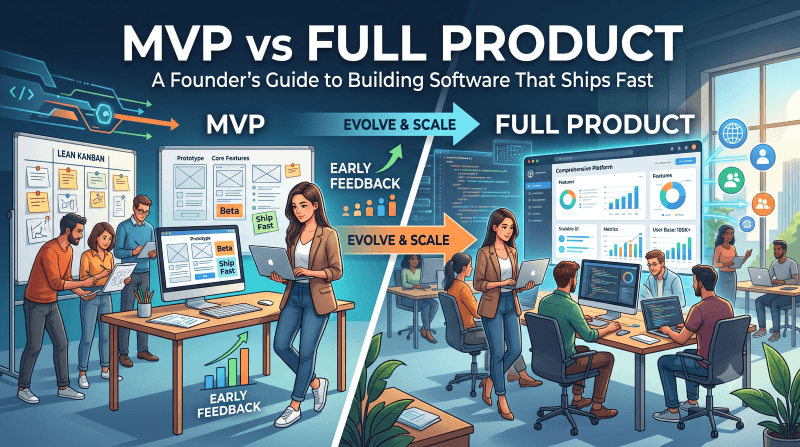
MVP vs Full Product: A Founder's Guide to Building Software That Ships Fast
TL;DR: Build an MVP if you're pre-product-market fit, have limited funding, or need to validate demand before committing $50K+. Go straight to a full product if you have clear customer demand, existing revenue, and the budget to build it right the first time. Most founders should start with an MVP — but the right MVP is more than a stripped-down prototype.
Every founder faces this moment.
You have a vision. A big one. You can see exactly how the final product will look — the perfect dashboard, the elegant workflows, the seamless integrations. And then reality hits: you have a budget, a timeline, and a team that can only build so fast.
Do you build the MVP? Or go for the full product?
It's one of the most consequential decisions you'll make as a founder. Build too little, and you might miss the market. Build too much, and you might run out of runway before anyone pays you.
This guide gives you a clear framework to decide — with real numbers, real examples, and a process that's worked for 125+ projects.
What's the Difference? (Plain English)
Let's kill the jargon.
| MVP (Minimum Viable Product) | Full Product | |
|---|---|---|
| Goal | Learn what customers actually need | Deliver the complete vision |
| Scope | The smallest thing you can sell | Everything on the roadmap |
| Timeline | 6–12 weeks | 6–18 months |
| Cost | $10K–$35K | $50K–$200K+ |
| Risk | Low — fail fast, cheap | High — big bet on assumptions |
| Users | Early adopters who tolerate imperfection | Mainstream customers |
An MVP is not a "crappy half-built thing." It's the fastest, cheapest version of your product that delivers core value to a paying customer.
A full product is the polished, feature-complete version you eventually want — but you might not know what that is until you ship the MVP and learn from real users.
When to Build an MVP (Do This First)
Build an MVP when any of these are true:
✅ You haven't validated demand yet
You have a hypothesis, not proof. An MVP is your cheapest experiment.
Example: A fitness startup wanted to build a full marketplace connecting yoga trainers with students worldwide. Instead of building everything at once, they launched with:
- A basic trainer directory
- Manual scheduling (via WhatsApp + email)
- Stripe payments
Result: They validated demand in 8 weeks with paying customers on both sides of the marketplace — and used the revenue to fund the full platform. That startup is now FitnessKriya, a full-featured global platform.
✅ You have limited runway
If you have 12 months of funding, spending 6 of them building means you have 6 months to find product-market fit. That's tight.
An MVP in 8 weeks gives you 10 months to iterate, sell, and grow.
✅ You need investor traction
Investors fund traction, not ideas. A working MVP with 100 paying users is worth more than a perfect pitch deck with a $200K build quote.
What investors actually want to see:
- Real users (even 50–100)
- Revenue (even $1K/month)
- Retention (users coming back)
- Feedback loop (you're learning fast)
You can get all of this from a well-built MVP.
✅ Your core value is in ONE feature
Ask yourself: If we could only build ONE feature, which one would make people pay us?
Build that. Nothing else.
Real example: A pincode-finder startup (Code of Bharat — another ProgigaTech project) started as a single search box. Type a pincode, get the location. That was it. Once people started using it daily, they added APIs, batch lookups, and enterprise features.
When to Go Straight to Full Product
Skip the MVP and build the full product when:
🏁 You already have validated demand
You're replacing an existing product, upgrading from a manual process, or customers are literally asking you to build it.
Example: If you run a service business and 30 clients have already said "I'll pay $200/month for a dashboard that does X" — you don't need an MVP. You need a product.
🏁 You have the budget
If you have $100K+ allocated and a 6–9 month timeline, you can afford to build more. But be careful — more money doesn't mean you should build everything. Scope creep is the #1 killer of funded startups.
🏁 You're serving enterprise clients
Enterprise buyers expect:
- Security compliance (SOC2, GDPR)
- Admin controls and role management
- SLA guarantees
- Integration with their existing tools
You can't sell an MVP to a Fortune 500. Enterprise requires a higher baseline.
🏁 Your MVP is the full product
Some products are simple enough that the "MVP" is the whole thing. A landing page with a booking widget, a portfolio site, a simple subscription service — these don't need phasing.
The Real Cost Comparison
Let's put real numbers on it. Here's what 125+ projects have taught us about the economics of MVP vs Full Product:
| Scenario | MVP Route | Full Product Route | Difference |
|---|---|---|---|
| Time to launch | 8–12 weeks | 6–9 months | 4–6 months faster |
| Initial investment | $15K–$30K | $60K–$120K | 3–4× cheaper |
| Pivot cost | $5K–$10K | $30K–$60K | 80% cheaper to change course |
| Revenue start | Week 10 | Month 7 | 4 months earlier revenue |
| Runway consumed | 2–3 months | 6–9 months | Preserves 3–6 months |
The math is stark: A founder with $100K in funding who builds a full product has $30K left for marketing and operations after 7 months of development. A founder who builds an MVP has $70K+ left after 2 months — and is already generating revenue.
The MVP Trap: What Most Founders Get Wrong
❌ Trap 1: Building a "demo" instead of a product
An MVP must work for real users in real conditions. A clickable Figma prototype is not an MVP. A half-baked beta with no onboarding is not an MVP.
The test: Can a stranger land on your site, sign up, and get value without emailing you for help? If not, it's not viable.
❌ Trap 2: Cutting the wrong corners
Good MVPs cut features, not quality. If your site is slow, broken on mobile, or looks unprofessional, users will assume your whole product is low-quality.
Cut: Features, pages, integrations, automation
Never cut: Design quality, performance, security basics, onboarding
❌ Trap 3: No measurement plan
An MVP without success metrics is just a side project. Before you build, define:
- Activation: What does a user need to do in the first session to "get it"?
- Retention: Do they come back within 7 days? 30 days?
- Revenue: Are they willing to pay? How much?
- Feedback: What's the one question you're trying to answer?
❌ Trap 4: Building the MVP alone
Founders who try to build their MVP themselves (while running the business) often end up with:
- 6 months of late-night coding
- A mediocre product
- Burnout
- No customers
A professional MVP build costs $15K–$30K and takes 8–12 weeks. That's usually cheaper than a founder's own time, and the quality is dramatically better.
The Smart Founder's Framework: How to Decide
Use this decision tree:
Do customers already pay for a solution to this problem?
├── YES → Do they complain about existing solutions?
│   ├── YES → Build Full Product (validated demand + pain)
│   └── NO  → Build MVP (demand exists but is it urgent enough?)
└── NO → Do people actively search for a solution?
    ├── YES → Build MVP (validate willingness to pay)
    └── NO  → Do more customer research before building anything
Still unsure? Default to MVP. It's the lower-risk, higher-learning path for 80% of software products.
A Proven 3-Phase MVP Process
Here's exactly how we build MVPs at ProgigaTech:
Phase 1: Discovery (Week 1)
- User interviews with 5–10 potential customers
- Define the single core value users will pay for
- Map the minimum user journey (entry → activation → value)
- Choose tech stack that scales (Laravel + React, or Flutter for mobile)
Deliverable: A 1-page product brief + wireframes
Phase 2: Build (Weeks 2–7)
- Agile sprints with weekly demos
- Build only what's in the product brief (resist scope creep!)
- Test with real users at week 4
- Iterate based on feedback
Deliverable: A working, deployable product
Phase 3: Launch & Learn (Weeks 8–12)
- Soft launch to 20–50 beta users
- Measure activation, retention, and willingness to pay
- Collect structured feedback (don't ask "do you like it?" — ask "what would make you pay?")
- Decide: Pivot, Persevere, or Scale
Deliverable: Data-driven decision on next phase + roadmap for v2
Real Case Study: FitnessKriya
Let's look at a real example from our portfolio.
The Vision: A global platform connecting yoga trainers in India with students worldwide — with live classes, scheduling across time zones, subscription management, and admin controls.
The MVP (8 weeks, $18K):
- Basic trainer profiles with photos and availability
- Manual class scheduling (confirmed via email)
- Stripe payment integration
- WhatsApp notifications
What they learned:
- Demand was real — 50 trainers signed up in week 1
- Students wanted recording access for missed classes (not in MVP)
- The US market was willing to pay 3× what they expected
- Daylight saving time was a bigger challenge than anticipated
The Full Product (16 additional weeks):
- Automated scheduling with multi-timezone support
- Class recording & library
- Subscription plans (monthly, quarterly, yearly)
- Admin dashboard with analytics
- Scalable cloud infrastructure
The Result:
- 3× year-over-year user growth
- 99.9% uptime
- 5-star client rating
- A world-class platform serving students globally
The MVP didn't "waste" time — it saved months of building features nobody needed and revealed the features that actually mattered.
Build vs Buy: Should You Hire an Agency or Do It Yourself?
| DIY | Freelancer | Agency (like ProgigaTech) | |
|---|---|---|---|
| Cost | $0 (your time) | $5K–$15K | $15K–$35K |
| Quality | Variable | Good | Professional |
| Speed | Slow (you learn as you go) | Medium | Fast (8–12 weeks) |
| Scalability | Poor (rewrite later) | Medium | Built to scale |
| Accountability | None | Limited | Full (SLA, warranty) |
| Best for | Side projects, learning | Simple MVPs | Funded startups, serious products |
Our recommendation: If this is your core business (not a side project), hire professionals. The cost of a bad MVP — lost time, lost market opportunity, technical debt — far exceeds the agency fee.
Ready to Build Your MVP?
At ProgigaTech, we've built 25+ MVPs for startups that went on to raise funding, acquire customers, and scale globally. Our MVP process is designed to get you from idea to paying users in 8–12 weeks.
Here's what a free consultation covers:
- We review your idea and ask the hard questions
- We give you a ballpark estimate and timeline
- We outline exactly what your MVP should include (and what it shouldn't)
No pitch. No pressure. Just honest advice from a team that's been there.
📅 Book Your Free MVP Strategy Call →
Free · 30 minutes · No commitment
Frequently Asked Questions
How much does an MVP cost to build?
A professional MVP from a development agency ranges from $10,000 to $35,000 depending on complexity. Simple web apps start around $15K. Mobile apps and marketplace platforms start around $25K. At ProgigaTech, most MVPs land in the $15K–$25K range.
How long does an MVP take to build?
8–12 weeks for a well-scoped MVP. Week 1 is discovery and planning. Weeks 2–7 are development. Weeks 8–12 are testing, launch, and iteration.
What if my MVP fails?
That's the point! An MVP failure means you learned something critical for $15K instead of $150K. You either pivot based on what you learned, or you discovered the market isn't ready — and saved yourself a year of wasted effort. Failure is data.
Can I start with an MVP and then add features?
Yes — that's exactly the point. A good MVP is built on a scalable architecture so that v2, v3, and v4 build on the same codebase. You're not throwing away the MVP — you're growing it.
What's the difference between an MVP and a prototype?
A prototype is a clickable mockup (Figma, InVision) — no real code, no real data, no real payments. An MVP is a real, working product that real users can sign up for and pay for. A prototype validates design. An MVP validates the business model.
Do investors fund MVPs?
Yes — if the MVP shows traction. 100 paying users on a basic MVP is more convincing to investors than a perfect product with zero users. Many Y Combinator companies launched with what we'd call MVPs.
.png)
